
Comet
Mars exploration application design

Team
Solo project
Year
2023
My role
Research, UI Design, User interview, Ideation, UX design
Audience
18 - 50+ years age group
Research tactics
Focused group interview, Competitor Analysis, Persona, Empathy Map, User Scenario
With space tourism becoming more real, especially the idea of traveling to Mars, this project focuses on designing a user-friendly mobile app to make the journey easier and more enjoyable for future space travelers. The aim was to create an intuitive and engaging UI/UX that supports every part of the trip — from booking tickets to getting help during the flight — all tailored for a once-in-a-lifetime experience beyond Earth.
Challange
With space tourism to Mars becoming a near-future reality, the need arises for an app that can simplify an entirely unfamiliar and high-stakes journey. Unlike conventional travel, this experience involves intensive preparation, long-duration spaceflight, and adapting to life on another planet.
Objective
To create a user-friendly mobile application that guides future space tourists through every step of their Mars journey — from pre-flight training and ticket booking to arrival and exploration.
Design process
We followed a five stage design thinking method proposed by Hasso Plattner Institute of Design at Stanford (the d.school) to understand user’s need and come up with effective solution.

Desk research
Secondary research involved reviewing science fiction films, studying official space agency websites, analyzing technical articles, and watching educational YouTube videos. This broad investigation focused on how organizations train astronauts, coordinate mission logistics, and manage life‑support systems during space travel. Insights from these sources helped inform realistic training flows and onboard experiences for future space tourists.

Intent mapping
We began by framing a series of key questions to define the direction of the project. This helped us uncover user needs, establish a clear vision, and outline what success would look like.

Focused group interview
We chose six people for face to face interview to understand user’s needs, motivation problem faced during space travel. During the interview we noted key points to refer back for the next step.
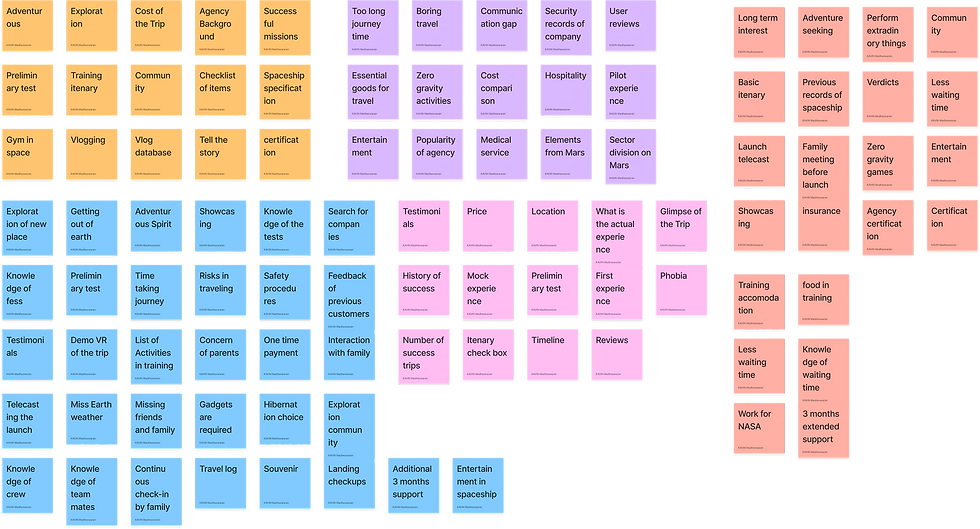
Affinity mapping
Followed by user interview we clustered a large volume of mixed information in a organized manner to make sense.

Persona

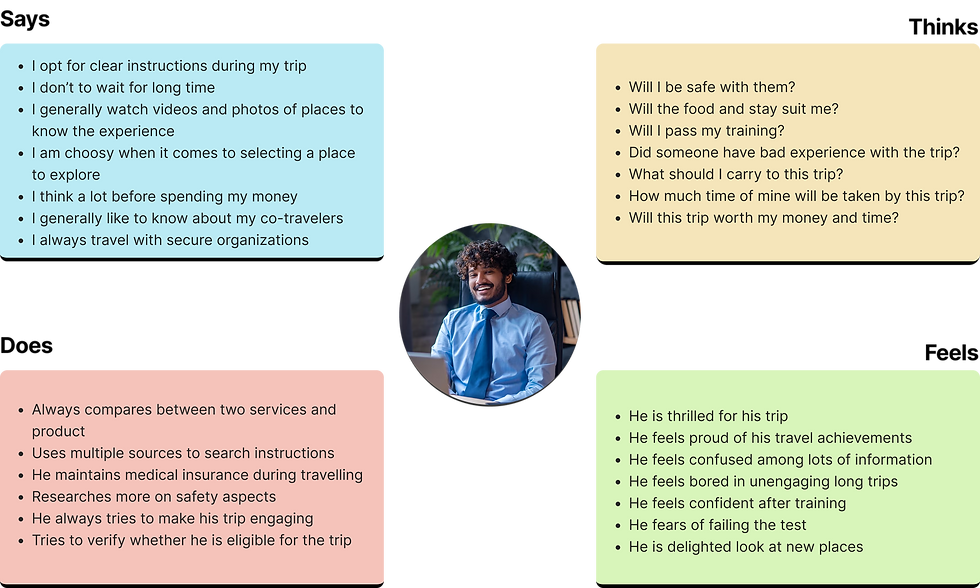
Empathy map
User scenario

Problem statement
“A travel enthusiast who works in a multi national company needs a safe hassle free travel support system for his Mars journey because it is hard to find information in a streamlined way and he doesn’t want to waste his time and money”
How might we statement
After getting user insights through persona and empathy map, “How Might We” questions were formulated to frame our design challenges which paved the way for next ideation phase.
How-Might-We ?
-
Provide information and itinerary at the right time?
-
Ensure his safety during his journey?
-
Provide a streamlined booking process?
-
Prevent his money and time from getting wasted?
-
Keep them engaged during his journey?
-
Create a memorable journey?
Ideation
For ideation we used brainstorming, brain walking and worst possible idea methods. After that for filtering out the best ideas Now-Wow-How method was applied.
Identity

App colour and typography

Information architecture
Information architecture was developed by conducting card-sorting sessions with users. These sessions revealed users’ perspectives on information hierarchy and priority.

Wireframe
With the information architecture finalized, wireframes were created to define the app’s structure, layout, and user flow.

Application usage scenarios

Final design
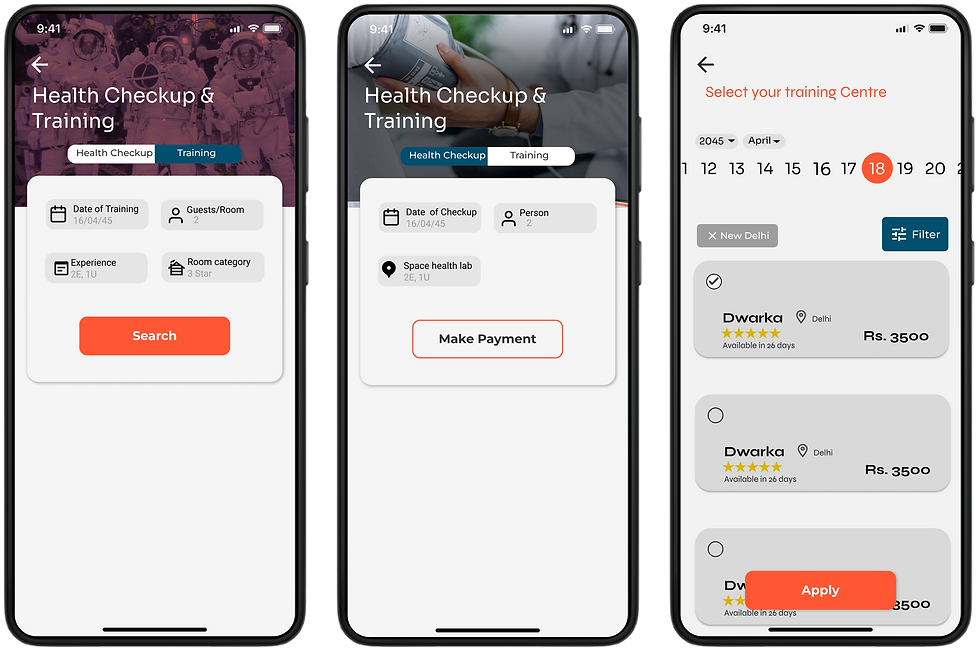
A high-fidelity mockup of the application was created based on wireframe.
Log in page

Home page

Training booking page
Flight booking page

Health, profile and customisable suite page

AI assistance page

Next Project

Final thoughts
-
User testing received positive responses. Five children aged 6 to 10 played the game and found it easy to understand and engage with.
-
There is a noticeable lack of clear and high-quality bird sound recordings in the public domain, making it a challenging aspect of developing this game
-
Further development is needed for levels two, three, and four. These levels will be refined after conducting additional user testing, and the feedback received will be thoughtfully incorporated into the game.